

How to Reduce Stress at Work: Practical Strategies for a Healthier Workday
Work can be rewarding, meaningful, and an important part of everyday life. But when workloads become excessive, priorities remain unclear, or you feel unable to disconnect, work can also become a major source of stress.
Learning how to reduce stress at work is not simply about becoming more productive or learning to tolerate more pressure. It is about identifying what is creating strain, deciding what you can change, communicating your needs, and creating healthier boundaries around your working day.
Some workplace stressors can be managed through individual habits. Others require changes in workload, communication, expectations, or working conditions. The most effective approach is often a combination of both.
This guide explains practical ways to reduce stress at work without turning your entire life into another productivity project.
Table of Contents
Why Does Work Cause So Much Stress?
Work-related stress can develop when job demands exceed the resources and support available to employees. Understanding the psychosocial risks that affect mental health at work can help explain why workload, poor communication, and limited support contribute to workplace pressure.
The World Health Organization identifies excessive workloads, long working hours, low control over work, limited support, unclear roles, difficult workplace relationships, job insecurity, discrimination, and conflicting work and home demands among the psychosocial risks that can affect mental health at work.
Common sources of workplace stress include:
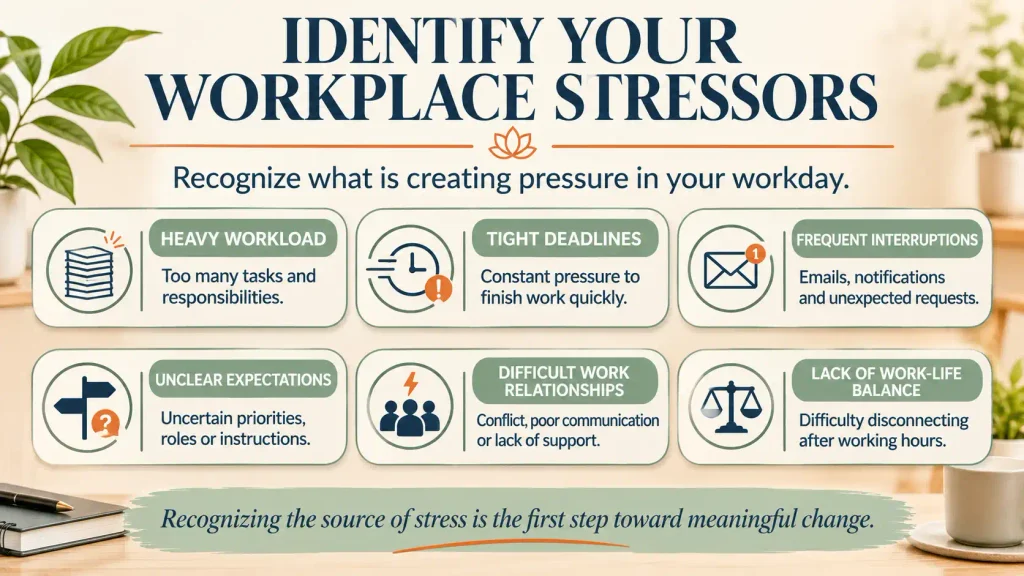
- Too many tasks and competing deadlines
- Constant interruptions
- Unclear expectations
- Lack of control over your schedule or workload
- Difficult communication with colleagues or managers
- Too many meetings
- Working outside normal hours
- Pressure to always be available
- Fear of making mistakes
- Difficulty separating work from personal life
- Changes, uncertainty, or job insecurity
Before trying to reduce stress, it helps to understand which of these factors is affecting you most.
How to Reduce Stress at Work
1. Identify Your Biggest Workplace Stressors
One of the most useful first steps is to identify exactly what is creating pressure.
Instead of writing down only “work is stressful,” look for the specific situation behind the feeling.
For example:
| Situation | Possible stressor | Possible response |
|---|---|---|
| Several deadlines fall on the same day | Conflicting priorities | Ask which task should come first |
| Messages interrupt you constantly | Digital overload | Create notification-free periods |
| You regularly work late | Unrealistic workload | Discuss priorities and deadlines |
| You keep redoing tasks | Unclear expectations | Clarify what “done” means |
| Meetings consume most of the day | Poor time structure | Question whether every meeting is necessary |
Try this simple formula:
Situation → Stressor → What I can control → Next action
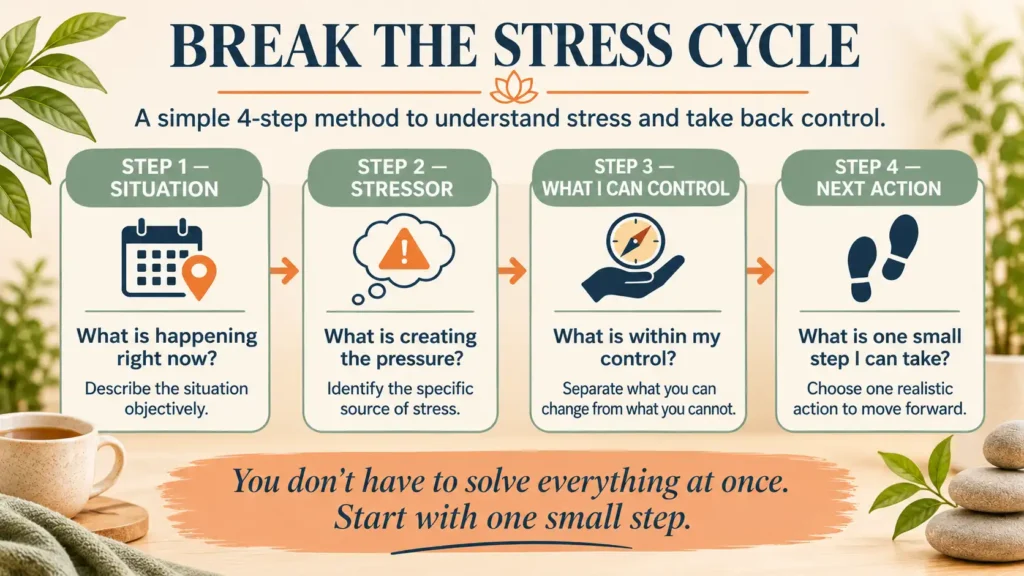
This turns a vague feeling of overwhelm into a problem that can be examined more clearly.
The NHS also recommends identifying what is causing work-related stress before deciding what to change.
If you want to understand the broader signs that stress may be affecting your body, emotions, and behavior, see our guide to common signs of stress.
2. Separate Urgent Tasks From Important Tasks
When everything feels urgent, your brain can remain in a constant state of reaction.
Instead of trying to complete everything at once, divide your workload into three simple groups:
Do now:
Tasks that genuinely require immediate attention.
Schedule:
Important work that needs a defined time but does not need to happen immediately.
Clarify or delegate:
Tasks where priorities, ownership, or deadlines are unclear.
This is not about squeezing more work into your day.
It is about reducing the mental load created by constantly deciding what to do next.
If several people are asking for different things, ask:
“Which of these priorities should I complete first?”
That simple question can prevent you from silently carrying conflicting expectations.
For broader strategies that apply beyond the workplace, you can also explore our guide to practical ways to reduce stress in everyday life.
3. Break an Overwhelming Workload Into Smaller Actions
A large project can feel stressful when you think about the entire workload at once.
Instead, identify the smallest useful next step.
For example:
Instead of:
“Finish the entire presentation.”
Try:
- Review the requirements.
- Create the presentation outline.
- Gather the necessary information.
- Draft the first section.
- Review and refine it.
The goal is not to work faster at all costs.
The goal is to replace “I have so much to do” with a clear next action.
4. Set Clear Boundaries Around Your Workday
Work stress can increase when work has no clear beginning or end.
This can happen particularly easily when working remotely or using a smartphone for work communication.
Useful boundaries may include:
- Turning off work notifications outside working hours
- Avoiding unnecessary work emails late at night
- Taking your scheduled breaks
- Defining when you are available
- Keeping your work area separate from your relaxation space when possible
- Creating a consistent end-of-work routine
Boundaries do not mean refusing every request.
They mean making your availability more predictable and protecting time needed for recovery.
The NHS specifically recommends practical boundaries such as finishing work on time, switching off work notifications outside working hours, taking breaks, and agreeing on realistic deadlines and workloads.
5. Learn to Say No or Renegotiate Priorities
One of the most difficult parts of workplace stress is feeling that you must accept every request.
But saying yes to everything can create an impossible workload.
Instead of simply saying:
“I can’t do that.”
Try communicating the constraint:
“I can complete this today, but I also have two other deadlines. Which task should take priority?”
Or:
“I can take this on, but I may need to move the deadline for the other project.”
This changes the conversation from personal failure to workload management.
You are not necessarily refusing the work.
You are asking for realistic priorities.
6. Reduce Unnecessary Workplace Interruptions
Constant interruptions can make an already demanding day feel even more exhausting.
Consider creating periods when you can work without unnecessary interruptions.
For example:
- Check email at defined times rather than continuously.
- Silence non-essential notifications.
- Close unused browser tabs.
- Avoid switching between tasks unnecessarily.
- Block focused work time on your calendar when appropriate.
- Let colleagues know when you are available for questions.
You do not need to eliminate communication.
The goal is to prevent every message from becoming an immediate demand on your attention.
7. Improve Communication Before Stress Builds
Unspoken problems often become more stressful over time.
If you are unclear about a deadline, workload, responsibility, or expectation, addressing it early can prevent unnecessary pressure.
You might ask:
“Could we clarify the expected deadline?”
Or:
“I want to make sure I understand which outcome is most important.”
Or:
“My current workload is at capacity. Can we review the priorities?”
Good communication can be especially important when workplace stress is connected to unclear responsibilities or limited support.
The WHO recommends workplace approaches that strengthen communication, active listening, and managers’ ability to recognize and respond to distress.
8. Take Short Recovery Breaks During Demanding Days
A workday does not have to be a continuous block of concentration.
Short breaks can create opportunities to step away from a demanding task and reset your attention.
Depending on your workplace, a short recovery break could mean:
- Standing up and moving around
- Getting some water
- Looking away from your screen
- Taking a brief walk
- Stretching
- Stepping outside for a few minutes
- Having a quiet moment away from your workspace
These breaks are not wasted time.
They can help create a healthier rhythm between effort and recovery.
For specific techniques such as breathing, grounding, mindfulness, and progressive muscle relaxation, see our guide to practical stress reduction techniques.
9. Create a Simple End-of-Work Routine
One of the easiest ways for work stress to follow you home is to finish the day without mentally closing it.
A simple transition routine can help.
At the end of your workday:
1. Review unfinished tasks.
Write down anything that still needs attention.
2. Choose tomorrow’s priorities.
Select the most important next steps.
3. Close work applications.
Give yourself a clear signal that the working day is ending.
4. Put away your work materials.
If possible, physically separate work from your living space.
5. Transition into something different.
Take a walk, prepare dinner, read, spend time with someone, or simply sit somewhere away from your workspace.
The purpose is not to create another complicated routine.
It is to give your mind a clear transition from work mode to personal time.
10. Use a Five-Minute Reset When You Feel Overwhelmed
Sometimes the problem is not the entire workday.
It is the moment when several demands arrive at once and you no longer know what to do first.
Try this simple five-minute reset:
Step 1 — Stop.
Pause before reacting to the next message or request.
Step 2 — Breathe.
Take a few slow, comfortable breaths.
Step 3 — Identify the immediate priority.
Ask: “What genuinely needs my attention first?”
Step 4 — Remove one distraction.
Close a notification, postpone a non-urgent task, or leave an unnecessary conversation.
Step 5 — Choose one next action.
Do not solve the entire day. Decide what comes next.
This approach is designed for moments of temporary overwhelm. It does not replace addressing a workload or workplace environment that is consistently unhealthy.
How to Cope With Stress at Work During a Difficult Day
If your workday is already stressful, you may not have the time or energy to completely reorganize your workload.
In that situation, focus on what is immediately within your control.
Try asking:
- What is the most important thing I need to finish today?
- What can wait?
- What can I clarify?
- What can I ask someone else about?
- What interruption can I postpone?
- What can I stop doing for the next hour?
You can also create a short reset between demanding tasks.
For example:
Finish one task → pause → review priorities → begin the next task.
This can be more realistic than trying to maintain perfect calm throughout the entire day.
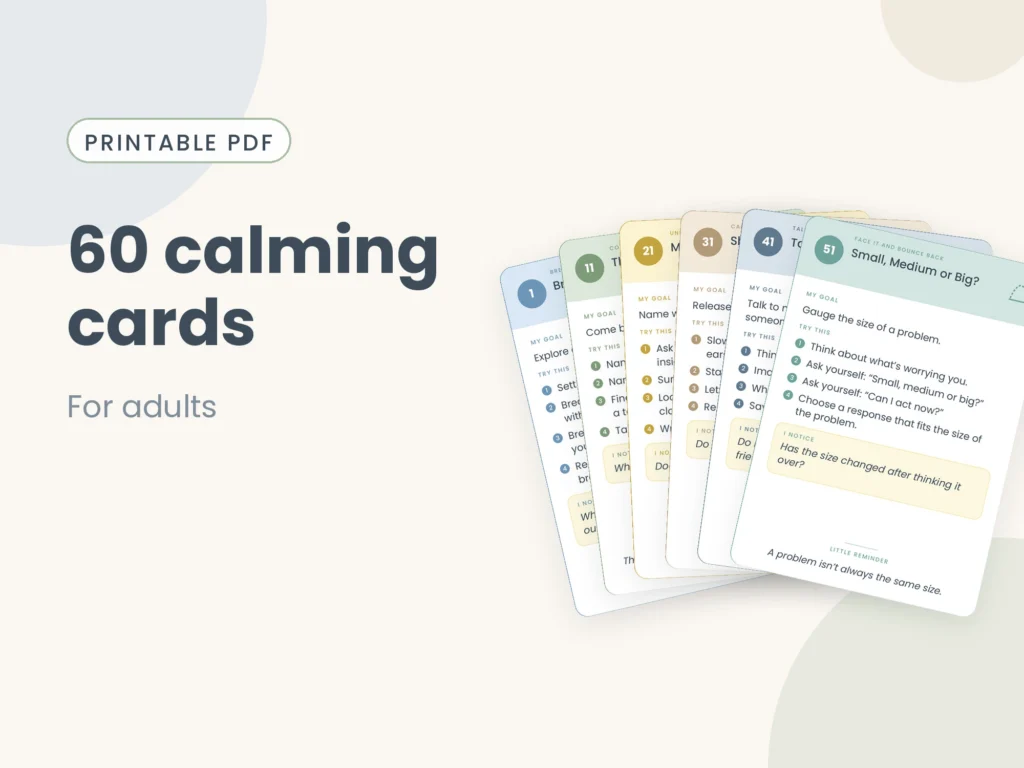
When workplace pressure becomes difficult to manage, having simple tools to support your emotional well-being can be helpful. Our 60 Calm Cards for everyday emotional well-being can help you explore practical self-care strategies, reconnect with the present moment, and approach everyday challenges with greater calm.
What If Your Workplace Is the Source of the Problem?
Not all workplace stress can be solved through individual habits.
If the underlying problem is an excessive workload, chronic understaffing, bullying, harassment, discrimination, unsafe conditions, lack of control, or persistent unreasonable expectations, simply telling yourself to “relax” may not address the real issue.
The WHO emphasizes that workplace mental health is influenced by organizational conditions, including workload, working hours, job control, support, role clarity, workplace culture, and safety.
In these situations, possible steps may include:
- Discussing workload with your manager
- Asking for clearer priorities
- Requesting realistic deadlines
- Using available workplace wellbeing resources
- Speaking with HR when appropriate
- Documenting serious workplace concerns
- Seeking professional advice when needed
- Learning about your workplace rights and available support
Individual coping skills can be useful, but they should not be used to place all responsibility on the employee for fixing an unhealthy work environment.
How to Tell When Work Stress Is Becoming Too Much
Occasional pressure is not necessarily a sign that something is seriously wrong.
However, persistent stress deserves attention, particularly when it begins to interfere with your everyday life.
You may want to take your situation more seriously if you notice:
- Persistent exhaustion
- Increasing difficulty concentrating
- Ongoing irritability or emotional distress
- Significant changes in sleep
- Losing motivation for activities you normally enjoy
- Increasingly withdrawing from others
- Feeling unable to recover after work
- Difficulty functioning in everyday life
For a broader overview of stress-related signs, read our article about common signs and symptoms of stress.
It is also important not to assume that every symptom is caused by stress. Physical or emotional symptoms can have many possible causes.
When Should You Seek Additional Support?
Consider speaking with a qualified health professional if stress is persistent, difficult to manage, significantly affecting your daily functioning, or causing substantial emotional or physical distress.
If your workplace itself is contributing to the problem, consider whether there are appropriate workplace resources, such as a manager, occupational health service, employee assistance program, HR team, union, or another trusted support channel.
The NHS recommends seeking additional help when you are struggling to cope or when the steps you have tried yourself are not helping.
If you are experiencing a mental health emergency or feel at immediate risk of harming yourself, seek urgent help through the appropriate emergency or crisis service in your country.
Talking with trusted colleagues, friends, or family members can make workplace challenges easier to navigate. The APA also explains how managing stress and building workplace support can contribute to better emotional well-being.
A Simple Daily Plan for Reducing Stress at Work
You do not need to change your entire working life overnight.
Start with a few manageable actions.
| Part of the day | Simple action |
|---|---|
| Start of work | Identify your top priorities |
| During focused work | Reduce unnecessary interruptions |
| Between demanding tasks | Take a short recovery break |
| When workload increases | Clarify priorities instead of silently accepting everything |
| Before finishing | Write down unfinished tasks |
| End of work | Close work apps and notifications when possible |
| After work | Create a clear transition into personal time |
The aim is consistency, not perfection.
A small boundary that you maintain regularly can be more useful than a complicated stress-management routine that you abandon after a few days.
Frequently Asked Questions
What is the fastest way to reduce stress at work?
Start by identifying the immediate source of pressure. If several tasks are competing for your attention, clarify which one is the highest priority. Then remove one unnecessary interruption and focus on one manageable next action.
How can I manage stress at work every day?
Focus on the factors you can influence: realistic priorities, clear communication, boundaries, short recovery breaks, and a consistent transition out of work. If the main source of stress is organizational, individual strategies may need to be combined with workplace changes.
How do I deal with an overwhelming workload at work?
Break the workload into clear priorities and discuss conflicting deadlines with the appropriate person. Instead of silently trying to complete everything, ask which tasks should come first and whether deadlines or responsibilities can be adjusted.
How can I cope with stress at work without taking time off?
During a difficult day, focus on one priority at a time, reduce unnecessary interruptions, take brief recovery breaks, communicate when your workload becomes unrealistic, and create boundaries around non-working hours. If stress remains persistent or severe, additional professional or workplace support may be appropriate.
When is work stress a sign that I need help?
Consider seeking additional support when stress persists, becomes difficult to manage, significantly affects your daily functioning, or is accompanied by substantial emotional or physical distress. Persistent workplace problems may also require organizational support rather than individual coping strategies alone.
Final Thoughts
Learning how to reduce stress at work is not about becoming better at tolerating unlimited pressure.
It is about understanding what is creating stress and responding at the right level.
Sometimes the answer is better prioritization.
Sometimes it is a boundary.
Sometimes it is a conversation about workload.
Sometimes it is a short recovery break.
And sometimes the real solution requires a change in the working environment itself.
Start with one manageable change. Identify what is creating the most pressure, decide what you can influence, communicate where necessary, and protect some space for recovery.
A healthier workday does not have to be a perfect workday.
It simply needs to leave enough room for you to work, recover, and live beyond your job.
Important note: This article provides general wellness information and is not a substitute for professional medical or mental health advice.