
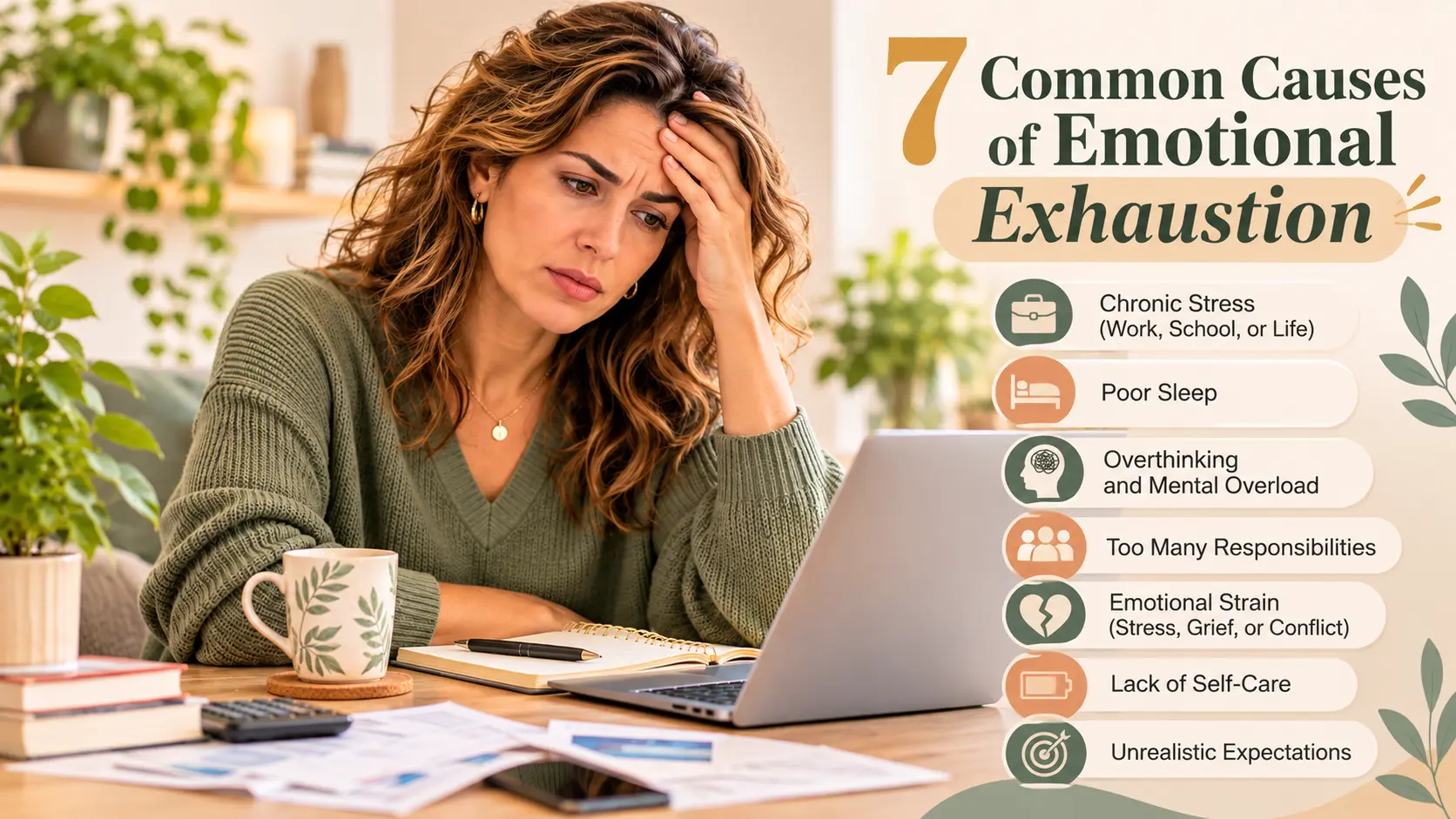
What Causes Emotional Exhaustion? Understanding the Root Causes
Have you ever wondered why you feel emotionally drained even when you haven’t done anything physically exhausting? Do everyday responsibilities seem increasingly difficult to manage, or do you feel overwhelmed by situations that once seemed manageable?
Emotional exhaustion often develops gradually, especially when ongoing stress and emotional demands leave little room for rest and recovery.
It can be connected to different aspects of life, including work pressure, relationship difficulties, family responsibilities, financial concerns, and major life changes. Sometimes, several stressors occur at the same time, making it difficult to identify exactly what is draining your emotional energy.
Understanding the causes of emotional exhaustion is an important step toward recognizing unhealthy patterns and finding more sustainable ways to manage everyday demands.
In this article, we’ll explore seven common causes of emotional exhaustion, explain how prolonged emotional pressure can affect your daily life, and discuss when professional support may be helpful.
Table of Contents
What Causes Emotional Exhaustion?
Emotional exhaustion can develop when a person experiences prolonged emotional demands or stressful circumstances without enough opportunities to recover.
It is not necessarily caused by one major event. In many situations, it results from the accumulation of smaller pressures over time.
For example, someone may be managing a demanding job, caring for family members, dealing with financial uncertainty, and trying to maintain relationships. Each responsibility may seem manageable individually, but together they can create a significant emotional burden.
The experience is different for everyone. Two people facing similar circumstances may respond differently depending on their personal resources, available support, previous experiences, and coping strategies.
The World Health Organization explains that stress is a natural response to difficult situations, but excessive stress can affect both mental and physical well-being.
Understanding where emotional pressure comes from can help you identify what may need to change.
Emotional exhaustion can develop gradually when stress, emotional demands, and daily responsibilities become overwhelming. Understanding its causes is an important step toward recognizing what may be affecting your emotional well-being.
If you want to learn more about the warning signs and practical ways to recover, read our complete guide to the signs of emotional exhaustion and how to recover.
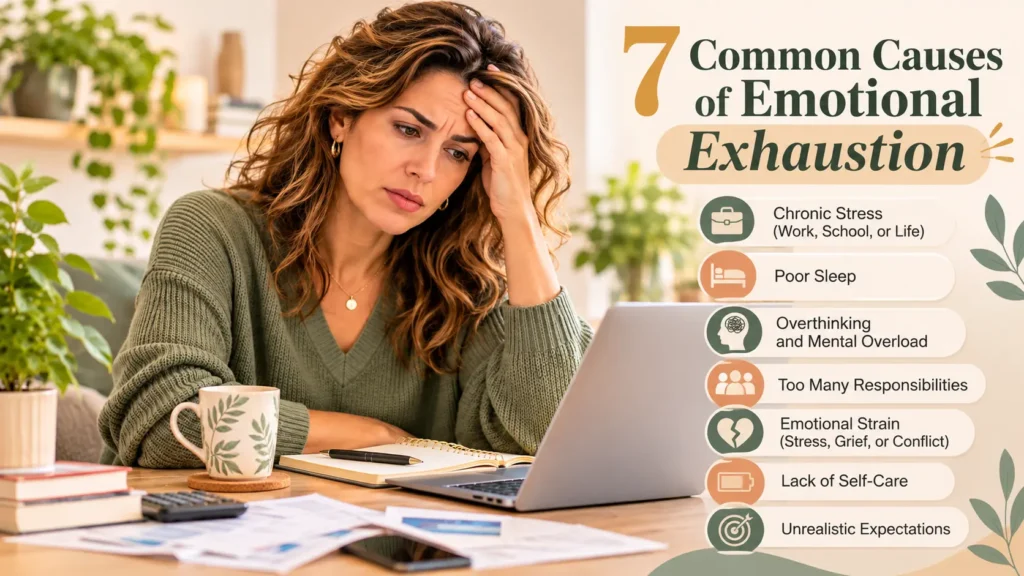
7 Common Causes of Emotional Exhaustion
1. Chronic Stress and Continuous Pressure
One of the most common contributors to emotional exhaustion is prolonged stress.
Stress can arise from different areas of life, such as work, family responsibilities, financial difficulties, health concerns, or uncertainty about the future.
The problem often develops when stressful situations continue without sufficient opportunities to rest, process emotions, or regain a sense of control.
For example, imagine someone who spends every day worrying about deadlines, household responsibilities, and financial obligations.
Even during quiet moments, their thoughts remain focused on what needs to be done next.
Over time, this continuous pressure may make it increasingly difficult to relax and feel emotionally available.
Why it can become exhausting:
- Your attention remains occupied by unresolved concerns.
- You may struggle to disconnect from responsibilities.
- Everyday challenges can begin to feel overwhelming.
- You may have fewer opportunities for meaningful rest.
When stress becomes a constant part of daily life, it is important to identify which demands can be reduced or better managed.
2. Excessive Workload and Professional Pressure
Work can provide structure, financial stability, personal development, and a sense of purpose. However, an unhealthy working environment can become an important source of emotional strain.
Excessive workloads, unrealistic expectations, long working hours, limited autonomy, and insufficient support can make professional responsibilities increasingly difficult to manage.
You may feel that you must constantly prove your value, meet demanding deadlines, or remain available even outside working hours.
Some people also experience emotional pressure when they have little control over their responsibilities or feel unable to express their concerns.
The UK Health and Safety Executive identifies six important areas of workplace stress: demands, control, support, relationships, role, and organizational change.
When these areas are poorly managed, they can contribute to work-related stress.
Situations that may increase workplace pressure include:
- Working long hours without adequate breaks.
- Managing more responsibilities than you can reasonably handle.
- Experiencing conflict with colleagues or supervisors.
- Receiving little recognition or professional support.
- Facing constant changes and unclear expectations.
- Feeling unable to maintain a healthy work-life balance.
It is important to recognize that the solution is not always to become more productive. Sometimes, the working conditions and expectations themselves need to be addressed.
3. Difficult Relationships and Emotional Conflict
Relationships can be a source of comfort, connection, and emotional support. However, ongoing conflict or unhealthy relationship patterns may create significant emotional pressure.
Repeated arguments, lack of communication, emotional manipulation, unresolved disagreements, and a lack of mutual understanding can make relationships emotionally demanding.
You may find yourself constantly trying to avoid conflict, explaining your feelings, or anticipating another difficult conversation.
In some situations, one person may feel responsible for maintaining the relationship while their own emotional needs remain overlooked.
Common relationship-related stressors include:
- Repeated disagreements without resolution.
- Feeling misunderstood or emotionally unsupported.
- Difficulty expressing your needs.
- Fear of disappointing someone you care about.
- Unequal emotional responsibilities.
- Lack of respect for personal boundaries.
Over time, maintaining a relationship under continuous emotional pressure can become exhausting.
Healthy relationships should allow room for communication, mutual respect, and individual needs.
4. Caregiving Responsibilities and Compassion Fatigue
Caring for someone you love can be meaningful, but it can also involve considerable emotional demands.
Parents, family caregivers, and people supporting loved ones with chronic illnesses or ongoing difficulties may spend much of their time responding to someone else’s needs.
They may manage appointments, daily activities, emotional support, household responsibilities, and difficult decisions.
The challenge becomes greater when caregiving responsibilities continue for months or years without sufficient assistance.
Some caregivers gradually stop prioritizing their own needs because they feel that someone else depends entirely on them.
Factors that can increase caregiver-related stress include:
- Limited time for personal activities.
- Insufficient help from family members.
- Financial and practical responsibilities.
- Worry about the person’s health or future.
- Difficulty balancing caregiving and professional life.
- Feelings of guilt when taking time away.
Caregivers may experience emotional strain, sleep difficulties, social isolation, and feelings of being overwhelmed.
It is important to distinguish emotional exhaustion from compassion fatigue and caregiver burnout. These concepts can overlap, but they are not interchangeable.
If you are supporting someone through a difficult period, remember that your own well-being deserves attention too.
5. Financial Problems and Uncertainty About the Future
Financial difficulties can create a persistent sense of uncertainty.
Concerns about debt, housing costs, unemployment, unexpected expenses, or the ability to support a family may occupy a significant amount of mental and emotional energy.
Even when you are not actively dealing with a financial problem, worrying about what might happen next can make it difficult to relax.
For example, someone experiencing financial insecurity may constantly calculate expenses, postpone personal needs, or feel anxious about unexpected situations.
Financial stress may contribute to emotional pressure through:
- Constant worry about monthly expenses.
- Fear of losing financial stability.
- Difficulty planning for the future.
- Tension within family relationships.
- Feeling unable to make important life decisions.
Financial concerns are not simply a matter of positive thinking. They may involve real economic difficulties that require practical solutions and appropriate support.
Breaking larger problems into manageable steps and seeking reliable financial guidance may help reduce some of the uncertainty.
6. Major Life Changes, Loss, and Difficult Experiences
Life transitions can require significant emotional adjustment, even when they are expected or positive.
Moving to a new place, changing jobs, becoming a parent, ending a relationship, experiencing bereavement, or dealing with a health problem can disrupt familiar routines and create uncertainty.
Sometimes, several major changes happen close together, leaving little time to process each experience.
Grief, in particular, can involve a wide range of emotional responses. People may experience sadness, anger, confusion, guilt, or difficulty imagining what life will look like afterward.
Other stressful transitions may require people to rebuild routines, adapt to unfamiliar responsibilities, or reconsider important life decisions.
Major life events that may contribute to emotional exhaustion include:
- The loss of a loved one.
- Divorce or relationship separation.
- Relocation and social disconnection.
- Becoming a parent.
- Job loss or career changes.
- Serious health concerns affecting you or someone close to you.
There is no universal timeline for adjusting to difficult experiences. Allowing yourself time and seeking support when needed can be important parts of the process.
7. Neglecting Your Own Emotional Needs
Another important contributor to emotional exhaustion is consistently placing your own needs last.
Some people become so focused on meeting expectations and supporting others that they gradually lose touch with their own emotional limits.
They may feel uncomfortable saying no, asking for help, or taking time to rest.
This pattern can be particularly difficult for people who associate their personal value with being helpful, productive, or constantly available.
For example, you might accept additional responsibilities even when your schedule is already full because you do not want to disappoint anyone.
Over time, this can leave very little space for activities that support your own well-being.
Signs that you may be neglecting your emotional needs include:
- Rarely making time for yourself.
- Feeling guilty when you rest.
- Ignoring your own feelings to avoid conflict.
- Struggling to communicate personal boundaries.
- Prioritizing everyone’s needs except your own.
- Feeling responsible for problems you cannot control.
Caring about other people does not require you to ignore your own needs.
Recognizing your limits is an important part of maintaining healthier relationships and a more sustainable daily routine.
How Multiple Stressors Can Lead to Emotional Exhaustion
Emotional exhaustion does not always result from one identifiable problem.
In many cases, several stressful circumstances interact and reinforce one another.
Consider this example:
Sarah works full-time in a demanding environment. She also supports an aging parent, manages household responsibilities, and worries about her family’s financial situation.
At first, she manages everything reasonably well.
However, as time passes, she has fewer opportunities to relax. Her work becomes more difficult to manage, family responsibilities increase, and financial worries occupy her thoughts even during personal time.
Eventually, she begins to feel emotionally overwhelmed.
This example illustrates how different stressors can accumulate and create a heavier emotional burden than any single responsibility might suggest.
It also explains why identifying the underlying causes is often more useful than focusing exclusively on individual symptoms.
What Happens When Emotional Pressure Continues?
When stressful circumstances remain unresolved, they can affect several aspects of everyday life.
Effects on Emotional Well-Being
Prolonged stress may contribute to irritability, anxiety, feelings of helplessness, and difficulty managing emotions.
Some people also experience emotional disconnection or reduced interest in activities they previously enjoyed.
Effects on Relationships
Emotional pressure can make communication more difficult.
You may become less patient, withdraw from social activities, or struggle to express your needs.
This can create additional tension in relationships, particularly when the people around you do not understand what you are experiencing.
Effects on Work and Daily Responsibilities
When your attention is occupied by multiple stressors, concentrating and making decisions may become more difficult.
You might struggle to prioritize tasks, maintain motivation, or manage responsibilities that previously felt manageable.
Effects on Physical Well-Being
Stress can also affect the body.
The World Health Organization identifies possible effects such as sleep difficulties, headaches, body pain, digestive discomfort, and changes in appetite.
These symptoms are not specific to emotional exhaustion and may have other explanations. Persistent or concerning physical symptoms should be discussed with a healthcare professional.
How Can You Identify the Main Causes of Your Emotional Exhaustion?
Understanding your personal stressors can help you decide where to begin.
Instead of trying to change everything at once, take some time to observe the situations that repeatedly leave you feeling overwhelmed.
Here are five questions to consider:
1. Which situations make me feel most emotionally drained?
Think about recurring responsibilities, relationships, or situations that create emotional pressure.
2. Do I have enough time to rest and recover?
Consider whether your daily routine allows sufficient time for sleep, relaxation, and personal activities.
3. Am I taking on responsibilities that are not entirely mine?
Think about whether you feel responsible for solving other people’s problems or meeting unrealistic expectations.
4. Do I have people I can turn to for support?
Consider whether you feel comfortable expressing your concerns and asking for practical or emotional assistance.
5. What is one thing I could change this week?
Choose a realistic action rather than creating a long list of additional responsibilities.
You may find it helpful to write your answers in a journal and revisit them over time.
What Can You Do When You Recognize the Causes?
Once you have identified some of the factors contributing to your emotional strain, you can begin exploring appropriate changes.
Depending on your circumstances, these might include:
- Discussing workload expectations with your employer.
- Asking family members to share caregiving responsibilities.
- Establishing clearer boundaries in relationships.
- Seeking practical help with financial difficulties.
- Making time for rest and enjoyable activities.
- Reconnecting with people you trust.
- Speaking with a qualified mental health professional.
Not every stressor can be removed immediately. Some situations require time, external support, or broader changes.
The goal is not to control everything around you but to identify where meaningful adjustments are possible.
For a more detailed guide to recognizing warning signs and exploring recovery strategies, read our article: Signs of Emotional Exhaustion: 15 Symptoms & How to Recover.
When Should You Seek Professional Support?
If emotional strain becomes persistent, overwhelming, or starts interfering with your ability to manage everyday activities, consider speaking with a qualified healthcare or mental health professional.
Professional support may be particularly important if you experience:
- Persistent feelings of sadness or anxiety.
- Significant changes in sleep or appetite.
- Difficulty maintaining work or family responsibilities.
- Increasing social withdrawal.
- Loss of interest in activities that previously mattered to you.
- A sense of hopelessness or difficulty coping.
Emotional exhaustion is not a diagnosis by itself. Similar experiences can occur alongside depression, anxiety disorders, sleep problems, and physical health conditions.
A professional can help explore possible causes and determine what type of support may be appropriate.
If you are experiencing severe distress or thoughts of harming yourself, seek urgent help through local emergency services or a qualified crisis-support service.
Frequently Asked Questions About the Causes of Emotional Exhaustion
What is the most common cause of emotional exhaustion?
There is no single cause that applies to everyone. Prolonged stress, excessive responsibilities, difficult relationships, workplace pressure, and insufficient emotional support can all contribute.
Can a relationship cause emotional exhaustion?
Yes. Repeated conflict, lack of communication, emotional manipulation, and unequal responsibilities may create ongoing emotional pressure within a relationship.
Can work cause emotional exhaustion?
Yes. Excessive workloads, long working hours, limited control, unclear responsibilities, and inadequate workplace support can contribute to prolonged stress and emotional depletion.
Why do I feel emotionally exhausted without doing anything physically demanding?
Emotional and mental effort can be demanding even when you are not physically active. Persistent worrying, difficult decisions, unresolved conflicts, and ongoing responsibilities may consume considerable mental energy.
Can emotional exhaustion develop gradually?
Yes. It may develop over time as different stressors accumulate. Because the changes can be gradual, some people do not recognize the underlying problem immediately.
Is emotional exhaustion the same as burnout?
Not exactly. Emotional exhaustion can occur in different areas of life, whereas the World Health Organization defines burnout specifically in relation to chronic workplace stress that has not been successfully managed.
Can emotional exhaustion affect relationships?
Yes. Prolonged emotional strain may make communication, patience, and emotional availability more difficult. It can also lead some people to withdraw from social interactions.
How can I prevent emotional exhaustion?
There is no guaranteed way to prevent every form of emotional strain. However, recognizing stressors early, establishing realistic boundaries, seeking support, and allowing time for recovery may help reduce the impact of ongoing demands.
Final Thoughts: Understanding the Causes Is the First Step
Emotional exhaustion is rarely the result of a single difficult day.
It may develop when professional pressure, family responsibilities, relationship difficulties, financial concerns, and personal expectations gradually accumulate.
Understanding these contributing factors can help you recognize patterns that may otherwise go unnoticed.
You do not need to change every aspect of your life immediately. Start by identifying what is placing the greatest pressure on you and consider which sources of support or practical changes may be available.
Most importantly, remember that taking care of your emotional well-being is not selfish. Your needs matter just as much as the responsibilities you carry.
Sometimes, understanding what is draining your emotional energy is the first step toward creating a healthier and more balanced life.
Understanding the causes is only one part of the process. To recognize the warning signs and explore practical recovery strategies, read our complete guide: Signs of Emotional Exhaustion: 15 Symptoms & How to Recover.